
In today’s competitive digital landscape, businesses need more than simply running advertisements across different platforms. Effective digital advertising requires a structured strategy that connects audience targeting, search intent, campaign objectives, conversion tracking, customer communication, and continuous optimization.
Google Ads and Meta Ads play different but complementary roles within this strategy. Google Ads allows businesses to capture users who are actively searching for products or services, while Meta Ads—across Facebook and Instagram—helps businesses build awareness, engage potential customers, generate leads, and drive direct conversations.
When these platforms are strategically integrated, businesses can create a more complete customer journey—from the first interaction with a brand to the final inquiry, lead, appointment, or conversion. This is especially important for businesses operating in competitive markets, where customers may interact with a brand several times before making a purchasing decision.
A strong performance marketing strategy therefore looks beyond individual advertisements. It considers the full funnel, the quality of traffic, the customer experience after the click, the sales follow-up process, and the data required to determine which marketing activities are producing real business value.
Understanding Google Ads for Business Growth
Google Ads is a performance advertising platform that enables businesses to reach potential customers based on search behavior, intent, and other signals. One of its strongest advantages is the ability to appear when a potential customer is actively looking for a specific product or service.
For example, a user searching for “digital marketing agency in Jordan” demonstrates a clear level of commercial intent. A well-structured Google Ads campaign can position a business in front of that user at a critical stage of the decision-making process.
For businesses, Google Ads can support several objectives, including:
- Generating qualified website traffic
- Increasing calls and direct inquiries
- Generating leads through dedicated landing pages
- Promoting specific products or services
- Capturing high-intent search demand
- Measuring conversions and campaign performance
However, successful Google Ads campaigns depend on more than selecting keywords and setting a budget. Campaign structure, keyword intent, match types, negative keywords, ad relevance, landing page experience, bidding strategy, conversion tracking, and continuous optimization all influence performance.
Search Intent and Keyword Strategy
Keyword selection should reflect the way potential customers search for a solution. High-intent terms often include commercial language such as “buy,” “service,” “agency,” “near me,” “pricing,” or specific product and service names. Informational searches may be useful at earlier stages of the funnel, while transactional searches can be more closely connected to conversion opportunities.
Businesses should also use negative keywords to reduce irrelevant traffic. This helps protect advertising budgets and improve the quality of search traffic.
Campaign Structure and Budget Control
A professional Google Ads account should be organized around meaningful business categories, services, products, locations, or customer segments. A clear structure makes it easier to control budgets, evaluate performance, write relevant ad copy, and identify opportunities for optimization.
Budget allocation should not be based only on which campaign receives the most clicks. It should be based on measurable outcomes such as qualified leads, calls, sales, conversion rate, cost per acquisition, and return on ad spend where revenue tracking is available.
The Role of Meta Ads in the Customer Journey
While Google Ads is particularly effective at capturing existing demand, Meta Ads can help businesses create and influence demand before a customer actively searches for a solution.
Facebook and Instagram provide businesses with audience targeting and optimization capabilities that can support different stages of the customer journey. Meta campaigns can be used to build awareness, generate engagement, drive website traffic, collect leads, encourage direct messages, and support retargeting.
This makes Meta Ads particularly valuable for businesses that need to introduce their products or services to new audiences while maintaining continuous communication with potential customers.
Audience Segmentation and Creative Strategy
Effective Meta advertising requires more than selecting a broad audience. Businesses can structure campaigns around different audience groups, such as new prospects, engaged users, website visitors, existing customers, or users who previously interacted with specific content.
Creative strategy is equally important. Different audiences may respond to different messages, offers, formats, and calls to action. Testing multiple creative concepts allows marketers to identify which combinations generate stronger engagement and conversion signals.
For example, an awareness campaign may focus on the problem a business solves, while a retargeting campaign can provide stronger proof, an offer, customer testimonials, or a direct call to action.
Retargeting and Re-Engagement
Not every visitor converts on the first interaction. Retargeting gives businesses an opportunity to reconnect with people who have already demonstrated interest. These audiences can include website visitors, people who engaged with social content, video viewers, or previous leads, depending on the available data and tracking setup.
Retargeting becomes especially powerful when the message reflects the user’s previous interaction rather than showing the exact same advertisement repeatedly.
Why Businesses Should Combine Google Ads and Meta Ads
The real advantage comes from understanding that Google and Meta do not necessarily compete with each other. Instead, they can work together as different stages of the same marketing funnel.
A potential customer might first discover a business through an Instagram advertisement. They may interact with the content without making an immediate inquiry. Later, they may search for the company or service on Google, where a search campaign can capture that existing intent.
The customer journey could look like this:
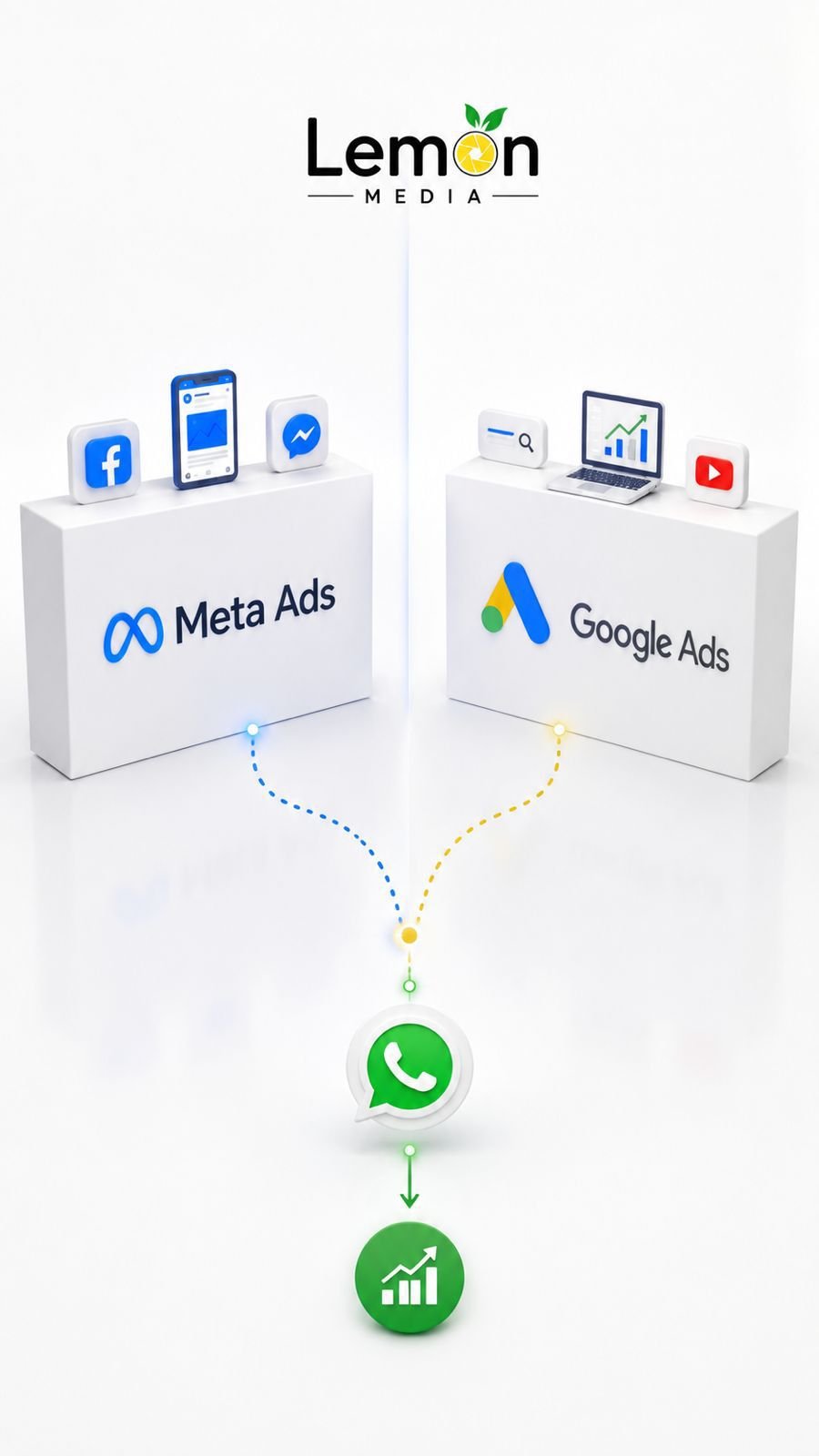
Meta Ad → Awareness → Engagement → Google Search → Website / Call → WhatsApp or Lead → Conversion
This integrated approach gives businesses more opportunities to reach potential customers throughout the decision-making process while allowing marketing teams to evaluate performance across multiple touchpoints.
Creating a Full-Funnel Strategy
A full-funnel strategy assigns a clear role to each advertising platform. Meta can help introduce the brand, communicate value, build engagement, and create demand. Google can capture users who move into active research or purchase intent.
The platforms can also support different retargeting and follow-up stages. Someone who watched a video or engaged with an Instagram post may later be exposed to a stronger lead-generation message. Someone who searches for a service may be directed to a landing page designed specifically around that search intent.
The goal is not to force every customer through the same path. The goal is to create multiple relevant opportunities for the customer to move from awareness to consideration and finally to conversion.
Connecting Advertising With Messaging
For many service-based businesses, generating a click is not the final objective. The real value comes from turning that interaction into a conversation, qualified lead, appointment, or sale.
That is why integrating advertising campaigns with messaging channels such as WhatsApp or Messenger can be highly effective. Instead of sending every user to a generic homepage, businesses can design campaigns around specific conversion actions.
Depending on the business model, a conversion path could look like:
Ad → Landing Page → Lead Form → Sales Follow-Up
or:
Ad → WhatsApp Conversation → Qualification → Sales Conversion
Messaging campaigns are particularly useful when customers need answers before making a decision. Services with customized pricing, appointments, consultations, or product questions can benefit from reducing friction between the advertisement and the sales conversation.
However, generating messages is only the first step. Businesses should also consider response speed, lead qualification, sales scripts, follow-up frequency, and the quality of the information collected. A campaign that generates a high number of messages but produces few qualified opportunities may need optimization at the sales or qualification stage rather than simply increasing the advertising budget.
The important point is that campaign performance should be evaluated beyond impressions and clicks. Businesses need to understand whether advertising is generating meaningful conversations, qualified opportunities, appointments, and measurable commercial outcomes.
Tracking, Attribution, and Performance Optimization
A successful multi-platform advertising strategy also requires accurate measurement. Businesses should be able to understand where leads are coming from, which campaigns generate meaningful actions, and how much each conversion costs.
Important performance indicators can include:
- Click-Through Rate (CTR)
- Cost Per Click (CPC)
- Conversion Rate
- Cost Per Lead (CPL)
- Return on Ad Spend (ROAS)
- Cost Per Acquisition (CPA)
- Number of qualified leads
- Message conversations
- Conversion value
These metrics should be interpreted according to the business objective. A campaign designed for awareness should not be evaluated in exactly the same way as a campaign designed to generate sales. Likewise, a low-cost lead is not automatically a good lead if the sales team cannot qualify or convert it.
Conversion Tracking
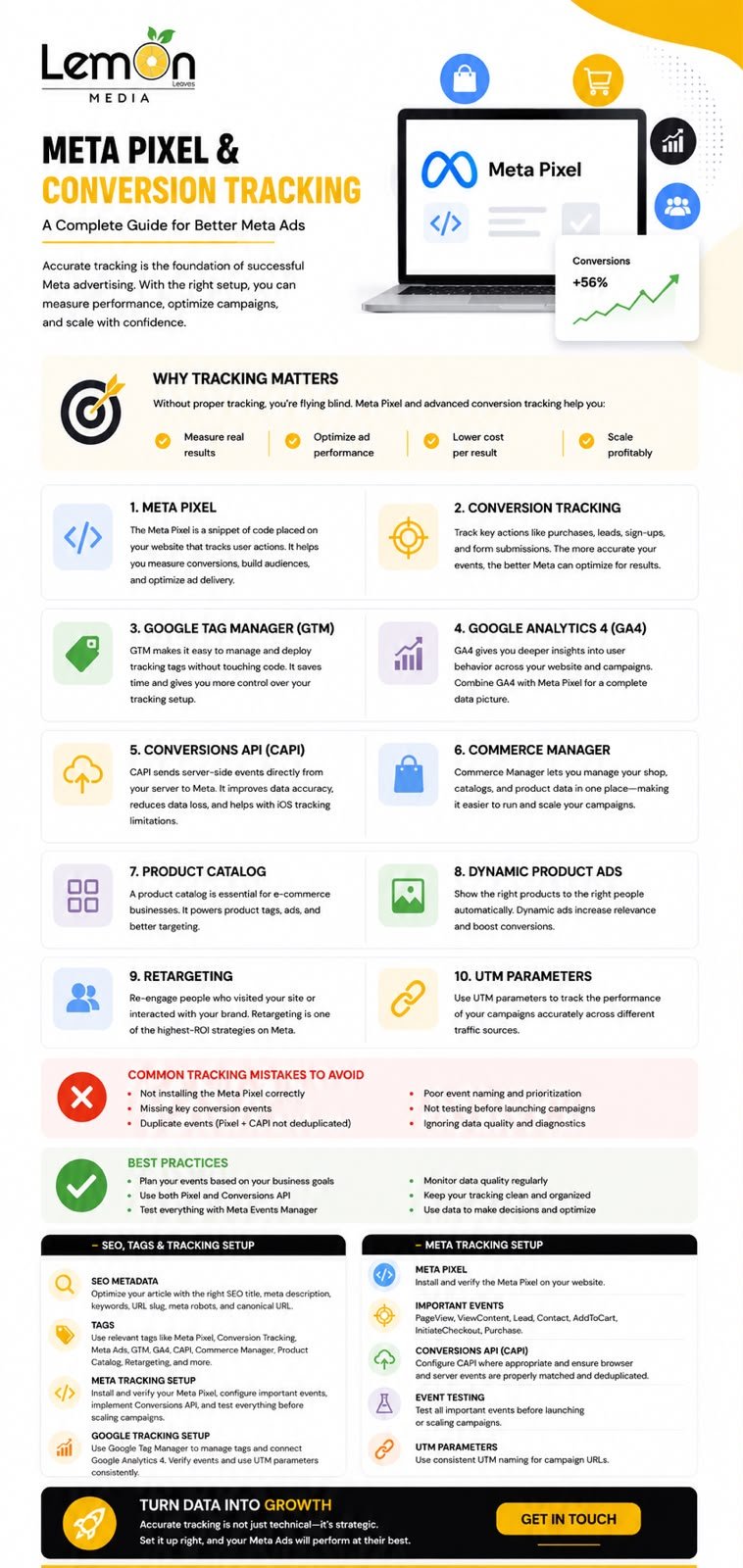
Conversion tracking allows businesses to connect advertising activity with specific actions. Depending on the business model, these actions can include purchases, form submissions, calls, bookings, or valuable messaging interactions.
Google Ads conversion tracking and Meta measurement tools can provide important signals for campaign optimization. When tracking is configured correctly, marketers can make decisions based on actual user behavior rather than assumptions.
Attribution and Cross-Platform Measurement
Customers can interact with multiple channels before converting. This makes attribution an important consideration when evaluating Google Ads and Meta Ads together. A customer may discover a brand through Meta, return through organic search, click a Google Ad later, and then contact the business through WhatsApp.
No single platform should automatically be viewed as the entire customer journey. Businesses should use available tracking and analytics data to understand the role of different touchpoints and avoid making budget decisions based only on surface-level platform metrics.
The objective is not simply to spend more on advertising. The objective is to allocate budget more efficiently, identify high-performing audiences and creatives, and continuously improve the relationship between advertising spend and business results.
How Tracking Improves Campaign Decisions
Accurate tracking creates a feedback loop between advertising and business performance. When marketers can identify which campaigns, keywords, audiences, advertisements, and landing pages contribute to valuable actions, optimization becomes more precise.
For Google Ads, this can mean identifying search terms that consistently produce qualified leads and reducing spend on traffic with weak commercial intent. For Meta Ads, it can mean comparing audiences and creative variations based on meaningful conversion signals rather than engagement alone.
Tracking can also reveal gaps after the advertisement. If a campaign generates many clicks but few form submissions, the landing page may require improvement. If it generates many messages but few qualified leads, the offer, audience, or sales qualification process may need to be reviewed.
This is why performance marketing should be treated as an ongoing optimization process rather than a campaign that is launched once and left unchanged.
Common Mistakes Businesses Should Avoid
Even with strong advertising platforms, campaign performance can suffer when the strategy or measurement framework is weak. Common mistakes include:
- Running campaigns without reliable conversion tracking.
- Choosing campaign objectives that do not match the actual business goal.
- Measuring success only through clicks, impressions, or low-cost leads.
- Using the same message for every stage of the customer journey.
- Sending paid traffic to a weak or irrelevant landing page.
- Failing to test audiences, creatives, offers, keywords, and messaging.
- Ignoring the follow-up process after a lead or message is generated.
- Scaling campaigns before enough reliable performance data is available.
- Treating Google Ads and Meta Ads as completely separate activities.
Paid advertising should be treated as a connected system rather than a collection of isolated ads. Strategy, creative, targeting, tracking, landing pages, messaging, and sales follow-up all influence the final result.
A Practical Integrated Advertising Framework
For businesses looking to combine Google Ads and Meta Ads effectively, the process can be structured around five core areas:
- Define the business objective: Determine whether the priority is sales, qualified leads, calls, messages, website conversions, bookings, or another measurable outcome.
- Map the customer journey: Identify where potential customers discover the business, where they research solutions, what information they need before converting, and where the final conversion takes place.
- Assign the right platform role: Use Google Ads to capture relevant search demand and Meta Ads to build awareness, engagement, lead generation, messaging, and retargeting opportunities.
- Connect tracking and messaging: Configure conversion events and connect campaigns to practical conversion channels such as landing pages, forms, calls, WhatsApp, or Messenger.
- Optimize based on business data: Review campaign performance regularly and adjust budgets, targeting, creatives, keywords, bidding strategies, landing pages, and follow-up processes based on measurable results.
This framework helps businesses move from platform-based advertising to a more integrated performance marketing model. It also makes it easier to identify where improvements are needed: acquisition, conversion, tracking, or sales follow-up.
Why Choose Lemon Media?
At Lemon Media Group, we approach digital advertising as part of a broader marketing strategy rather than as isolated campaigns. Our work includes strategic marketing, PPC, social media marketing, campaign management, and performance-focused advertising across search and social platforms.
We help businesses build campaigns around clear objectives, reach relevant audiences, generate leads and inquiries, and use performance data to improve advertising decisions. By combining Google Ads and Meta Ads with appropriate tracking, messaging, and optimization, businesses can create a more connected acquisition process and make better use of their advertising budget.
Our approach focuses on aligning campaign objectives with measurable business outcomes. This means looking beyond impressions and clicks and considering the complete path from audience exposure to engagement, inquiry, qualified lead, and conversion.
For companies looking to strengthen their digital presence, generate qualified opportunities, and turn paid traffic into measurable business results, Lemon Media Group provides the strategy, campaign management, and digital marketing expertise needed to move from advertising activity to business growth.
Google Ads and Meta Ads are most effective when they are treated as complementary parts of a performance marketing system. Google can capture high-intent demand at the moment users are actively searching, while Meta can build awareness, engagement, demand, and direct communication with potential customers.
When both platforms are connected through clear objectives, conversion tracking, audience strategy, messaging, and continuous optimization, businesses gain a stronger view of the customer journey and more opportunities to turn advertising investment into measurable results.
The goal is not simply to run more ads. The goal is to build a smarter advertising system that supports sustainable growth, improves the efficiency of marketing budgets, and creates a clearer connection between digital campaigns and real business outcomes.