

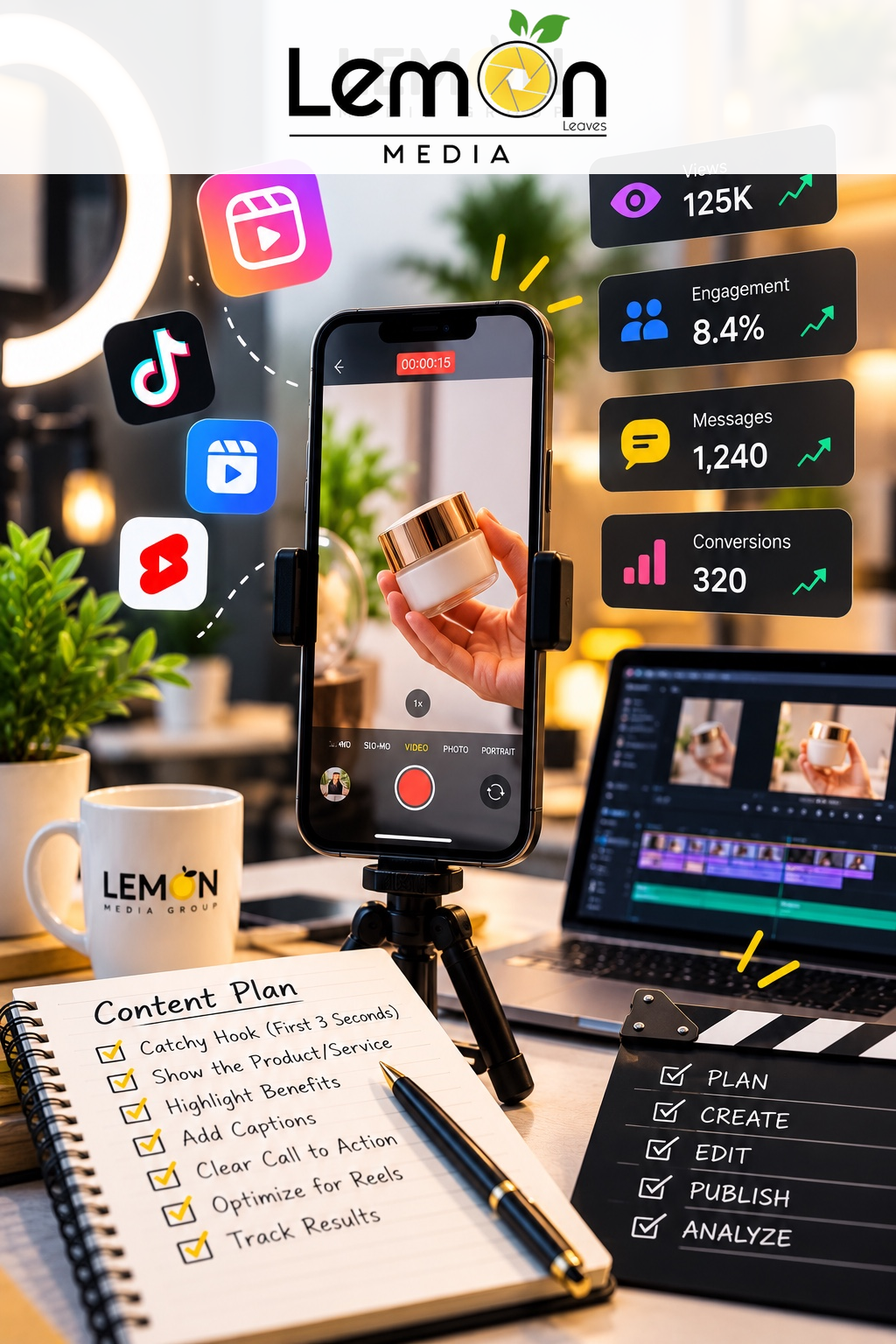
Short-form video has become a practical format for brands that need to explain products, demonstrate value, answer customer questions, and build familiarity. But publishing more videos does not guarantee better results. An effective strategy connects each video to a specific audience, a clear message, and a measurable next step.
What Is Short-Form Video Marketing?
Short-form video marketing uses concise videos distributed through channels such as Instagram Reels, Facebook Reels, TikTok, YouTube Shorts, or paid social placements. Depending on the platform and objective, a video may entertain, educate, demonstrate a product, answer a question, or encourage an enquiry.
The strongest format depends on the audience and message. A quick demonstration may suit a product, while a customer question or behind-the-scenes clip may be more useful for a service business.
1. Choose One Goal for Each Video
Before filming, decide what the video should accomplish. A single video can support several outcomes, but one primary goal makes the message easier to understand and the results easier to evaluate.
- Awareness: introduce the brand, category, or problem it solves.
- Education: explain a feature, process, misconception, or common question.
- Consideration: compare options, demonstrate quality, or address objections.
- Conversion: invite viewers to enquire, book, visit a store, or view a product.
- Retention: help existing customers use a product or get more value from a service.
2. Win Attention with a Relevant Hook
The opening seconds should quickly communicate why the viewer should keep watching. A hook does not need to be loud or exaggerated; it needs to be relevant to the audience.
- Problem-led: “Struggling to choose the right size?”
- Outcome-led: “Here is how to make this process simpler.”
- Demonstration-led: show the product working before explaining it.
- Question-led: answer a common question customers regularly ask.
Avoid misleading hooks that promise something the video cannot deliver. If the opening creates the wrong expectation, viewers may lose trust even if the video receives attention.
3. Use a Simple, Repeatable Video Structure
A short video can follow a straightforward structure that keeps production manageable.
- Hook: state the problem, benefit, or question.
- Context: explain why the topic matters to the viewer.
- Value: demonstrate, explain, compare, or answer.
- Proof: show a real product detail, process, example, or credible evidence.
- Call to action: tell the viewer what to do next.
Not every video needs all five parts in equal measure. A product demonstration may move directly from hook to proof, while an educational video may need more context.
4. Make the Video Easy to Watch on Mobile
- Film vertically when the intended placement is vertical video.
- Keep the subject well lit and the main action easy to see.
- Use clear audio and add accurate captions when useful.
- Keep important text away from interface elements that may cover it.
- Edit out pauses that do not add meaning, but do not remove context needed to understand the message.
Use platform-specific safe areas and preview the final upload on a phone. A video that looks polished in an editing app can be harder to read once platform buttons and captions appear.
5. Create Content Around Customer Questions
A sustainable content plan starts with what customers actually want to know. Sales conversations, comments, search queries, support messages, and frequently asked questions can all provide useful ideas.
- Product demonstrations: show how a product works and what makes it useful.
- Common questions: answer one question per video.
- Comparisons: explain which option fits which need, without making unsupported claims.
- Behind the scenes: show preparation, quality checks, or the people behind the business.
- Objection handling: address concerns about price, suitability, delivery, or the process.
- Customer stories: share genuine feedback or experiences with appropriate permission.
A repeatable series makes planning easier and helps audiences know what to expect. It also gives the team a consistent format to improve over time.
6. Match the Call to Action to the Goal
A call to action should feel like the natural next step after the video. Avoid asking viewers to do several unrelated things at once.
- For awareness: invite viewers to follow for more useful content.
- For consideration: direct viewers to a detailed product page or explainer.
- For enquiries: explain how to contact the business and what information to include.
- For local visits: provide accurate location and opening information.
- For sales: make the product, offer conditions, and purchase path clear.
If a video promotes an offer, ensure the terms, dates, and availability are accurate. Keep the landing page consistent with the message in the video.
7. Measure Business Results, Not Views Alone
Views can help show distribution, but they do not tell the full story. Choose metrics that match the video’s purpose and compare results across similar formats.
- Awareness: reach, impressions, and watch time.
- Engagement: shares, saves, meaningful comments, and completion behaviour.
- Traffic: link clicks and visits to the intended page.
- Lead generation: qualified enquiries, bookings, or completed forms.
- Sales: purchases, revenue, and cost per acquisition where reliable tracking is available.
Use consistent tracking links or campaign parameters when appropriate. Review which messages attract the right audience, not only which videos generate the largest number of views.
8. Test Creatives Systematically
Testing helps a team learn which creative choices work for a particular audience. Change one major element at a time where possible, such as the opening hook, demonstration, length, or call to action.
- Write down the hypothesis before publishing.
- Keep the audience and objective comparable when evaluating variants.
- Allow enough time and data to avoid overreacting to small fluctuations.
- Reuse successful concepts thoughtfully rather than reposting identical content without a plan.
Organic performance and paid performance can differ. A video that earns shares may not generate qualified leads, while a clear product demonstration may convert well with a smaller audience.
A One-Week Short-Form Video Plan
- Monday: answer one frequently asked customer question.
- Tuesday: demonstrate a product feature or service process.
- Wednesday: share a practical tip related to the audience’s needs.
- Thursday: address a common concern or misconception.
- Friday: show a real example, behind-the-scenes moment, or customer-approved story.
This is a starting framework, not a rule to publish every day. Adjust the frequency to the team’s capacity and prioritize consistency, usefulness, and quality.
Frequently Asked Questions
How long should a Reel be?
Use the length needed to deliver the message clearly. Shorter is not automatically better; remove material that does not help the viewer understand or act.
Do businesses need expensive equipment?
Not necessarily. A modern phone, good lighting, clear sound, and a well-planned message can be enough to start.
Should every video sell something?
No. Educational, entertaining, and trust-building content can support the wider customer journey. The overall content mix should still connect to business goals.
How often should a business publish videos?
Choose a sustainable schedule that the team can maintain. Review quality and results before increasing frequency.
Short-form video works best when creativity is supported by strategy. Start with a clear goal, build the video around a real customer need, make the message easy to follow, and measure the outcomes that matter. Lemon Media Group helps businesses connect content, social media marketing, creative direction, and wider digital strategy to build stronger relationships with their audiences.
Build a Content Plan That Can Be Sustained
A content calendar should reflect business priorities, audience questions, available resources, and the time required to create each video. A smaller number of useful videos is often more sustainable than a high-volume plan that quickly loses quality.
- Choose three to five recurring content themes connected to customer needs.
- Batch similar tasks, such as scripting several videos or filming multiple demonstrations in one session.
- Assign a clear owner for scripting, filming, editing, approval, publishing, and replies.
- Leave room for timely questions, seasonal needs, and ideas discovered through audience feedback.
Plan a mix of educational, demonstration, trust-building, and conversion-focused content. Review the mix every month instead of assuming that one format will work for every audience.
Make Product and Service Videos More Convincing
- Show the product in use rather than relying only on a static shot.
- Demonstrate a feature that solves a real customer problem.
- Explain who the product or service is suitable for and any important limitations.
- Show details that are difficult to communicate through a caption alone.
- Use real customer feedback only with permission and without changing its meaning.
- Keep prices, offer conditions, availability, and contact details accurate.
For service businesses, a short process walkthrough can reduce uncertainty: show what happens after booking, how a consultation works, or what information a customer should prepare. Do not reveal private customer information while filming.
Turn Video Insights into Better Creative
After publishing, review patterns across multiple videos. One unusually successful post may be affected by timing, distribution, or other factors, so avoid treating a single result as a universal rule.
- Identify which hooks retain attention among the intended audience.
- Compare demonstrations with talking-head explanations or customer-question formats.
- Look at saves, shares, qualified enquiries, and purchases when those actions match the goal.
- Read comments for recurring questions that can become future videos.
- Record what changed between creative versions and what the results suggest.
Use the findings to create the next test. The goal is a learning loop: plan, publish, measure, learn, and improve—not simply chase views or copy trends without a clear business reason.






Related Posts