

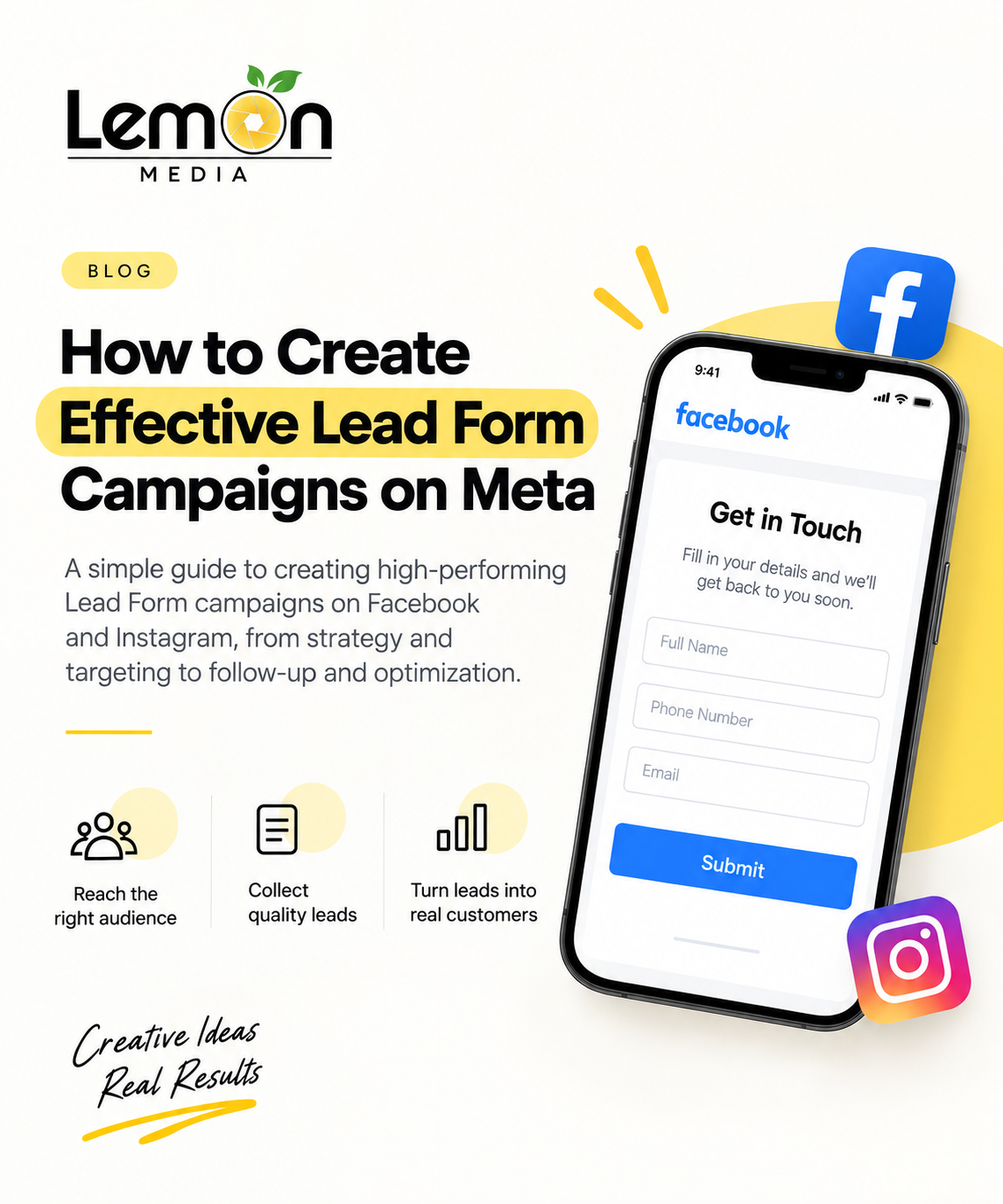
Lead Form campaigns are one of the most effective advertising methods for businesses looking to collect potential customer information and turn it into real sales opportunities. Meta allows businesses to create forms directly within Facebook and Instagram, making it easier for users to submit their information without leaving the platform.
However, creating a successful Lead Form campaign requires more than simply creating a form and launching an ad. It requires a clear strategy that starts with defining the campaign objective and target audience and continues through ad creation, form design, lead follow-up, and performance analysis.
What Are Lead Form Campaigns?
Lead Form campaigns are advertising campaigns designed to collect information from people who are interested in a specific product or service.
Depending on the campaign, the form may collect information such as the user’s name, phone number, email address, location, service preference, or other relevant details.
When users interact with the advertisement, they can open the form and submit their information directly through Facebook or Instagram. This makes the registration process faster and easier.
Lead Form campaigns can be effective for many types of businesses, including real estate companies, clinics, educational institutions, service providers, restaurants, automotive businesses, e-commerce brands, and B2B companies.
Define Your Campaign Objective
Before creating the campaign, it is important to define the main objective behind collecting leads.
Are you looking to receive quotation requests? Book appointments? Generate inquiries? Or collect information from people interested in a specific service?
Having a clear objective helps determine the right audience, advertising message, and questions to include in the form.
A successful campaign is not necessarily the campaign that generates the highest number of leads. The real value comes from generating leads that are relevant and have a genuine potential to become customers.
Choose the Leads Objective in Meta Ads Manager
The first step is to open Meta Ads Manager, create a new campaign, and select the Leads objective.
You can then choose how you want to collect your leads. One of the main options is Instant Forms, which allows users to complete the form directly within Facebook or Instagram.
The campaign settings should be aligned with your business objective and whether your priority is generating a higher volume of leads or improving lead quality.
Choose the Right Target Audience
Audience selection is one of the most important elements of a Lead Generation campaign.
Targeting a large number of people does not necessarily mean better results. A very broad audience may generate more leads, but some of them may have little interest in the product or service.
Start by understanding your ideal customer and define the relevant targeting factors, such as location, age, interests, and behaviors, depending on the nature of the business.
When enough data is available, businesses can also use Custom Audiences and Lookalike Audiences to reach people who share characteristics with existing customers or previous leads.
Create a Clear and Direct Advertisement
The advertisement should clearly explain why the user should complete the form and what they can expect after submitting their information.
A strong Lead Form advertisement should communicate the value of the offer clearly and include a direct call to action.
For example, the campaign could encourage users to request a quotation, book an appointment, receive more information, or speak with a sales representative.
The clearer the message, the easier it is for users to understand what they are signing up for.
Design the Lead Form Correctly
Once the advertisement attracts the user’s attention, the Lead Form itself becomes an important part of the customer journey.
The form should be simple, easy to complete, and focused on collecting information that the business actually needs.
Depending on the campaign, the form may include:
Name
Phone number
Email address
City or location
Required service
Approximate budget
Avoid adding unnecessary questions, as a long and complicated form may increase the number of users who leave before completing it.
Choose Your Questions Carefully
The questions in the form should help the business understand the customer’s needs and evaluate their level of interest.
For example, you can ask users about the service they are looking for, their approximate budget, or when they expect to need the service.
These questions do more than collect information. They also provide the sales team with useful context before contacting the potential customer.
Balance Lead Quantity and Lead Quality
There is an important difference between generating a high number of leads and generating high-quality leads.
A very short form can make registration easier and increase the number of submissions, but it may also generate leads from people who are not seriously interested.
On the other hand, a longer form can help qualify potential customers, but it may reduce the number of people who complete the form.
The goal is to find the right balance between Quantity and Quality based on the business model and sales process.
Include a Privacy Policy
When collecting personal information, businesses should provide a clear link to their Privacy Policy within the Lead Form.
Users should understand why their information is being collected and how it will be used, such as for contacting them about a requested service, quotation, appointment, or offer.
Make the Most of the Thank You Screen
After submitting the form, users will see a confirmation or thank-you screen.
This step can be used to encourage the user to take another action, such as visiting the website, contacting the business through WhatsApp, exploring additional services, or learning more about the company.
This allows the customer journey to continue instead of ending immediately after the form submission.
Follow Up With Leads Quickly
Collecting the lead is only the beginning.
One of the most important factors in Lead Generation is how quickly the sales team follows up with the potential customer.
Businesses should have a clear process for receiving new leads and transferring them to the appropriate sales representative as quickly as possible.
A CRM or lead management system can also be used to organize customer information and track the status of every lead.
Classify Your Leads
It is useful to classify leads after they reach the sales team.
For example:
New Lead
Contacted
No Response
Interested
Not Interested
Appointment Booked
Converted
This classification allows the marketing and sales teams to understand how many leads are actually progressing through the sales funnel instead of focusing only on the total number of submissions.
Measure the Right Campaign Metrics
A Lead Form campaign should not be evaluated based only on Cost per Lead.
Several metrics should be monitored to understand the actual performance of the campaign.
Cost per Lead
Shows how much it costs to generate one lead.
Lead Quality
Measures how relevant and valuable the generated leads are.
Qualified Leads
Shows how many leads meet the business’s qualification criteria.
Contact Rate
Measures the percentage of leads that the sales team successfully reaches.
Conversion Rate
Shows the percentage of leads that turn into appointments, sales, or other desired actions.
These metrics provide a more accurate picture of campaign performance than lead volume alone.
Test Different Versions
It is recommended to test different versions of your advertisements and forms instead of relying on a single version.
You can test:
Different videos or images
Different Primary Text variations
Different headlines
Different audiences
Different form questions
Different offers
After collecting enough data, compare the results and identify which elements are contributing to better performance.
Continuously Optimize the Campaign
Lead Generation campaigns require continuous monitoring and optimization.
If a campaign is generating a large number of leads but the quality is low, the issue may be related to the audience, advertisement, offer, or questions included in the form.
If the leads are high quality but the volume is low, you may need to test additional audiences, improve the creative, adjust the offer, or review the campaign budget.
Campaign optimization decisions should always be based on data rather than lead volume alone.
The Importance of Connecting Marketing and Sales
One of the most important aspects of Lead Generation is connecting advertising performance with actual sales results.
Marketing teams should not only know how many leads were generated. They should also understand how many leads were contacted, qualified, converted into appointments, and eventually became customers.
This connection allows businesses to identify which campaigns, audiences, and advertisements are generating valuable business opportunities.
Creating a successful Lead Form campaign on Meta requires a complete strategy that starts with defining the objective and target audience and continues with creating a clear advertisement and a simple, well-structured form.
However, the process does not end when the lead is submitted. Fast follow-up, lead qualification, performance tracking, and continuous optimization are essential for turning collected data into real business opportunities.
At Lemon Media, we focus on building integrated Lead Generation campaigns, from strategy and audience targeting to advertisement creation, Lead Form development, performance analysis, and continuous optimization.
Our goal is not simply to generate more leads, but to help businesses turn those leads into meaningful opportunities for growth and sales.






Related Posts