

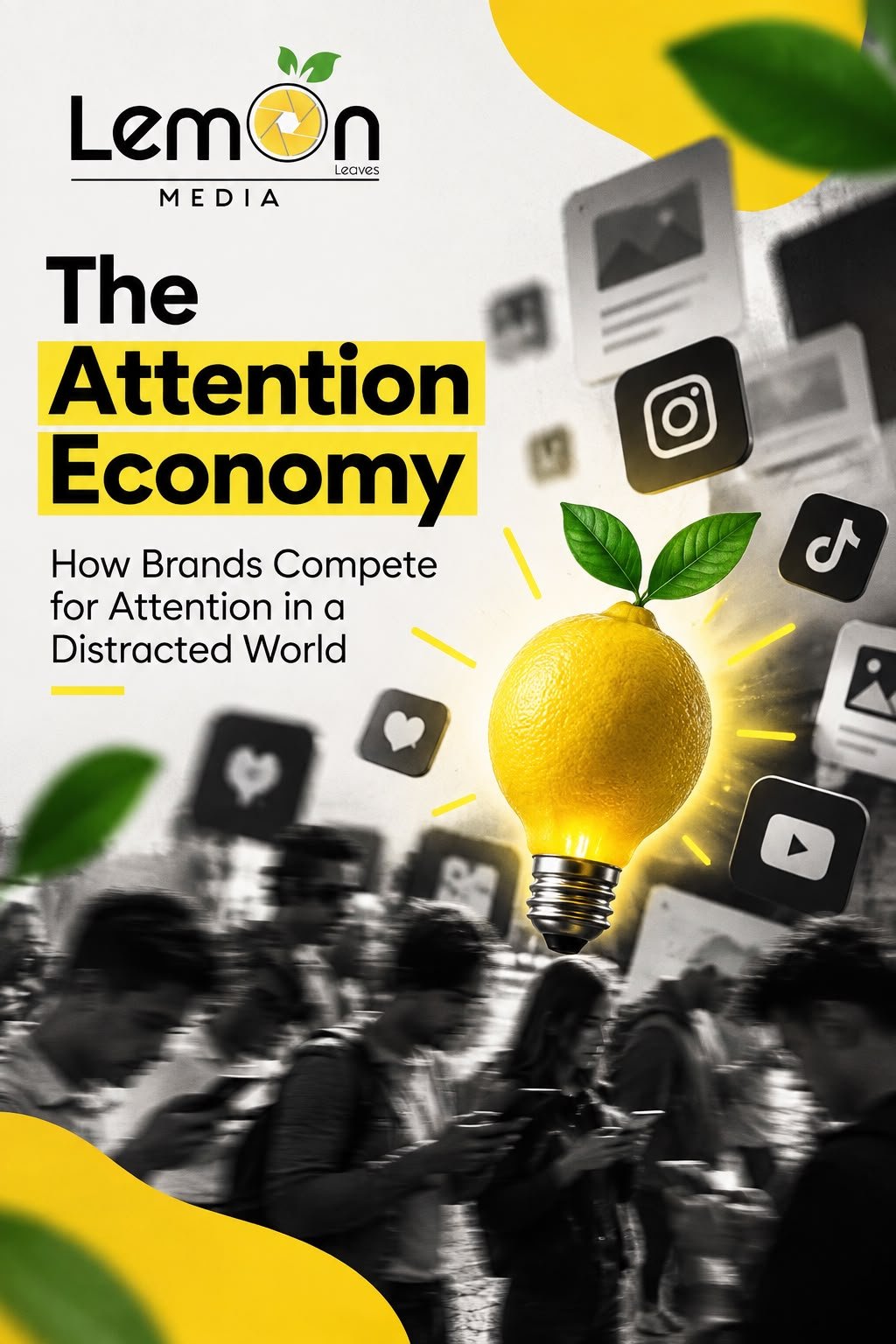
In today’s digital world, attention has become one of the most valuable resources for brands. People scroll through social media, watch short-form videos, answer messages, search for products, read reviews, and interact with countless pieces of content every day. The amount of information available is growing faster than the amount of time people have to consume it.
For businesses, simply being visible is no longer enough. A brand can reach thousands of people and still be forgotten seconds later. The real challenge is to earn attention, make the message relevant, create a memorable impression, and give the audience a reason to take the next step.
This is the idea behind the Attention Economy: a digital environment where human attention is limited, valuable, and constantly being competed for.
What Is the Attention Economy?
The Attention Economy describes a marketplace in which attention functions as a scarce resource. Consumers have limited time and mental capacity, while brands, creators, platforms, publishers, and advertisers all compete for a share of that attention.
Think about a normal day online. A customer may see a social media post, receive a notification, watch a video, search on Google, open an email, visit a website, and then move to another platform within minutes. Every piece of content is competing with everything else happening at that moment.
For marketers, this changes the question from “How can we reach people?” to “Why should people pay attention to us?”
Why Is Getting Attention So Difficult?
Consumers are exposed to a huge volume of messages every day. Over time, people become faster at deciding what deserves their attention and what they can ignore.
A business may have an excellent product, professional visuals, and a strong offer, but if the message is unclear or irrelevant, the audience may scroll past it. This is particularly important on social platforms, where users can move from one piece of content to another almost instantly.
Attention is also affected by context. The same message may perform differently depending on the platform, audience, timing, creative format, and customer intent. Effective marketing therefore requires more than visibility; it requires relevance.
The First Seconds Matter
Whether it is a short video, an advertisement, or a social media post, the opening moments can influence whether someone continues or moves on.
A strong opening can introduce a problem, ask a direct question, show a useful result, present an unexpected idea, or immediately communicate why the content matters. The goal is not to trick the audience into watching. The goal is to quickly establish relevance.
For example, a business selling productivity software could start with a common customer problem such as, “Still spending hours managing tasks manually?” That opening immediately identifies a situation that the intended audience may recognize.
Attention Is Not the Same as Engagement
Getting someone to notice a brand is only the first step. Attention does not automatically create interest, trust, or a sale.
A useful way to understand the journey is:
Attention → Interest → Engagement → Trust → Action
Attention gets the customer to notice the message. Interest encourages them to learn more. Engagement creates interaction. Trust reduces uncertainty. Action is the point where the customer takes a meaningful next step, such as contacting the business, visiting a website, signing up, or making a purchase.
This is why marketers should avoid judging a campaign only by how many people saw it. A message that attracts attention but provides no value may generate visibility without creating a meaningful customer relationship.
What Makes People Stop Scrolling?
There is no single formula that guarantees attention, but several principles can improve the chances that content will be noticed and understood.
Strong Visuals
People process visual information quickly. A clear image, video, design, or product demonstration can communicate an idea faster than a long block of text.
Strong visuals should support the message rather than distract from it. A creative design is useful when it helps the audience understand what the brand is offering or why the content matters.
A Clear Hook
The hook is the opening idea that gives the audience a reason to continue. It can be a question, a customer problem, a surprising insight, a useful promise, or a strong statement.
A good hook should connect naturally to the rest of the content. If the opening creates a promise that the content does not deliver, the brand may gain a click but lose trust.
Relevance
People are more likely to pay attention when a message reflects their needs, interests, goals, or problems. Understanding the target audience is therefore essential.
Instead of creating one generic message for everyone, brands can develop content around specific customer situations. Relevance makes the message feel less like an interruption and more like useful information.
Simplicity
Trying to communicate too many ideas at once can make content difficult to understand. A focused message is often easier to process and remember.
This does not mean every campaign needs to be minimal. It means that the audience should be able to understand the main point without working too hard to find it.
Authenticity
Audiences can recognize content that feels overly promotional or disconnected from reality. Brands can build stronger relationships when their communication feels clear, consistent, and genuine.
Authenticity does not mean avoiding professional marketing. It means making sure the message, visuals, offer, and customer experience are aligned.
The Goal Is Not to Capture Attention at Any Cost
There is an important difference between earning attention and simply demanding it.
Clickbait, misleading headlines, exaggerated claims, and excessive visual effects may attract short-term attention, but they can damage credibility when the content does not deliver what was promised.
Successful brands should ask two questions: “How can we get people to notice us?” and “What can we give people that makes their attention worthwhile?”
The second question is what turns attention into value.
5 Practical Ways Brands Can Win Attention
- Start with a real customer problem. Content becomes more relevant when it addresses something the audience actually experiences.
- Make the value clear early. Show the benefit, insight, solution, or idea before the audience loses interest.
- Adapt the creative to the platform. A message designed for a website does not always work the same way on Instagram, TikTok, YouTube, or search.
- Test different creative approaches. Brands can compare hooks, visuals, formats, messages, and calls to action to learn what resonates with their audience.
- Give people a reason to remember the brand. Consistent visual identity, distinctive messaging, useful content, and positive experiences can strengthen brand recall over time.
From Attention to Brand Recall
Getting noticed is valuable, but being remembered is even more important. A customer may see hundreds of advertisements during a week, while only a small number remain in memory.
Brand recall can be supported by consistent visual identity, recognizable design elements, clear positioning, repeated but meaningful messages, and experiences that match what the brand promises.
The objective is not simply to appear everywhere. It is to create a recognizable presence that customers can connect with a particular need, category, or experience.
How Brands Can Compete for Attention
To compete in the Attention Economy, businesses should think beyond publishing more content. They can focus on understanding what their audience actually cares about, creating content around real customer problems, developing stronger creative concepts, making the first few seconds meaningful, using clear and consistent brand messaging, testing different creative approaches, and studying audience behavior.
The strongest strategy is not necessarily to produce the most content. It is to produce content that deserves attention.
This is also where a broader digital marketing strategy matters. Social media, paid advertising, websites, creative design, analytics, and content should work together rather than operate as isolated activities.
The Role of Data in Understanding Attention
Creative ideas attract attention, but data helps marketers understand what happens next. Metrics such as engagement, click-through rate, time spent, conversions, and other campaign signals can provide clues about how audiences respond.
However, numbers need context. A high click-through rate does not automatically mean a campaign is successful, just as a large reach does not automatically mean people remember the brand.
The most useful approach is to connect performance data with a clear business objective. When creative testing and measurement work together, brands can learn which messages attract attention and which messages create meaningful action.
The Future of Marketing Is About Meaningful Attention
As digital platforms continue to grow, competition for attention will become even stronger. Brands will have more opportunities to reach consumers, but consumers will also have more ways to ignore marketing messages.
This means businesses need to think beyond impressions and reach. They need to create messages and experiences that people find useful, relevant, interesting, or memorable.
In the Attention Economy, being seen is only the beginning. The real challenge is earning attention, keeping it, and turning it into a meaningful relationship with the audience.
The question is no longer simply, How many people saw us?
It is: Did we give them a reason to remember us?






Related Posts